
If your Tuscany shower faucet is not hot enough, the most common cause is the temperature-limiting or anti-scald setting, not the water heater.
Tuscany single-handle shower valves commonly use pressure-balancing cartridges and an adjustable temperature limit. If that limit is set too conservatively—or the cartridge is sticking, clogged, or pressure-locked—the handle may never reach the amount of hot water you expect.
Here’s what to check first.
Tuscany Shower Not Hot Enough: Quick Troubleshooting
| Problem | Likely Cause | Check First |
| Shower is lukewarm at full hot | Temperature limit set too low | Anti-scald stop |
| Other faucets get much hotter | Shower valve/cartridge issue | Shower valve |
| Whole house has lukewarm water | Water-heater setting/problem | Heater temperature |
| Shower suddenly became cooler | Cartridge buildup or failure | Cartridge |
| Problem began after installation | Limit stop or supply connection | Installation setup |
| Hot side has weak flow | Supply restriction | Hot shutoff/inlet |
| Temperature changes when toilet flushes | Pressure-balance issue | Cartridge |
| Only cold water after plumbing work | Cartridge pressure-locked | Verify both supplies |
| Handle cannot rotate far enough | Mechanical limit stop | Limit device |
| Hot and cold seem reversed | Reversed supply/back-to-back setup | Valve orientation |
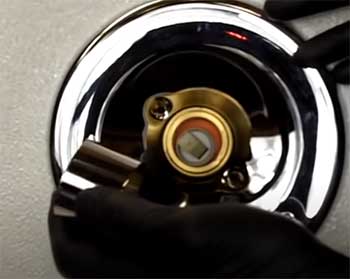
1. Check Other Hot-Water Fixtures First
Before opening the shower valve, determine whether the water heater is actually producing hot water.
Test:
- Bathroom sink
- Kitchen faucet
- Another shower
Let the hot water run long enough to reach full temperature.
Other Faucets Are Hot
If the sinks get noticeably hotter than the Tuscany shower, the shower valve is the likely problem.
Focus on:
- Temperature limit
- Cartridge
- Hot-water inlet
- Pressure-balance mechanism
Everything Is Lukewarm
If every fixture has the same problem, the Tuscany faucet is probably not responsible.
Check:
- Water-heater setting
- Water-heater capacity
- Mixing valve
- Hot-water system
2. Adjust the Temperature-Limiting Device
This should be one of your first checks on a Tuscany single-handle shower.
Many Tuscany pressure-balanced valves include an adjustable temperature-limiting device or anti-scald stop.
Its purpose is to prevent the handle from rotating far enough to deliver dangerously hot water.
If it is set too low, the shower can feel lukewarm even though plenty of hot water is available.
On Some Tuscany Valves
The limit device is located behind the handle and trim.
On models such as the Tuscany Free Fall, the temperature limit uses a red adjustment component.
The highest-temperature position is factory-defined, while moving the limiter toward the lower-temperature positions reduces how far the valve can travel toward hot.
Do not assume the exact adjustment direction is identical on every Tuscany faucet.
Check your model before moving the stop.
How to Adjust the Anti-Scald Limit
The exact parts vary, but the general procedure is:
- Turn off the shower.
- Remove the handle trim cap.
- Remove the handle retaining screw or lock nut.
- Pull off the handle.
- Locate the temperature-limiting stop.
- Move it slightly toward the hotter setting.
- Reinstall the handle.
- Test the water temperature.
Make small adjustments.
Do not simply remove the temperature stop and leave the valve unrestricted.
Test With a Thermometer
Do not judge the maximum temperature only with your hand.
Use a thermometer in the shower stream.
A common residential hot-water target is around 120°F at the heater, while a comfortable shower is normally considerably cooler because the valve mixes hot and cold water.
Increasing the shower limit too far can create a scald hazard.
If children, elderly adults, or anyone with reduced temperature sensitivity uses the shower, be especially conservative.
3. The Cartridge May Be Sticking
If the anti-scald setting is correct but the shower still will not get hot enough, the pressure-balance cartridge may be sticking.
Tuscany shower faucets commonly use a pressure-balanced ceramic cartridge.
Inside the valve, the cartridge controls:
- Hot/cold mixing
- Flow
- Pressure balancing
Mineral buildup can prevent the internal components from moving through their full range.
That may limit the amount of hot water reaching the outlet.
Signs of a Cartridge Problem
Suspect the cartridge if:
- Shower used to get hotter.
- Maximum temperature gradually decreased.
- Handle feels stiffer than before.
- Temperature fluctuates.
- Hot-side flow seems restricted.
- Anti-scald adjustment makes little difference.
In hard-water areas, scale buildup becomes more likely as the valve ages.
4. Cartridge May Need Replacement
Cleaning does not always restore a worn pressure-balance cartridge.
Replacement becomes more sensible when the cartridge:
- Sticks repeatedly
- Has damaged seals
- Is visibly worn
- Cannot maintain stable temperature
- Restricts hot water even after cleaning
Tuscany sells model-specific replacement cartridges.
Do not buy a cartridge simply because it says “Tuscany.”
Different faucet models can use different cartridges.
Identify the faucet before ordering the part.
5. Cartridge Can Become Pressure-Locked
This is a particularly useful Tuscany-specific troubleshooting point.
On some Tuscany pressure-balanced shower valves, both the hot and cold supplies must be turned on before operating the faucet.
If one side is shut off while the other is pressurized, the pressure-balance cartridge can become pressure-locked.
That can result in:
- Very weak flow
- Only one temperature
- No hot water
- Strange cartridge behavior
This can happen after:
- Plumbing repair
- Installation
- Using integral service stops
- Shutting off only one supply
What to Check
Make sure both:
- Hot supply
- Cold supply
are fully open.
Then operate the valve again.
If the cartridge remains stuck, it may need to be removed and reset or replaced.
6. Integral Stops May Not Be Fully Open
Some Tuscany shower valves include integral service stops.
These allow the hot and cold water supplies to be shut off at the valve for servicing.
If the hot-side stop was not fully reopened after maintenance, the shower may receive:
- Normal cold flow
- Restricted hot flow
The result is lukewarm water even with the handle at maximum hot.
Check both service stops if your valve has them.
7. Hot-Water Inlet May Be Partially Blocked
Debris can enter the shower valve after:
- Water-main repair
- Pipe replacement
- Water-heater work
- New construction
- Valve installation
Possible debris includes:
- Rust
- Scale
- Solder
- Pipe fragments
- Sediment
If debris blocks the hot inlet more than the cold inlet, the shower will not reach normal temperature.
This can happen suddenly after plumbing work.
Flush the Valve After Installation
Tuscany installation instructions for some models specifically recommend running water through the faucet after installation to clear loose debris.
If the temperature problem began immediately after installation, debris should be high on your troubleshooting list.
The cartridge may need to be removed so the valve body can be flushed safely.
8. Water Heater May Be Set Too Low
If every hot-water fixture feels cooler than expected, check the water heater.
For a tank-style heater, verify:
- Temperature setting
- Burner or heating elements
- Recovery
- Mixing valve if fitted
For a tankless heater, check:
- Set temperature
- Flow rate
- Error codes
- Scale buildup
- Gas/electrical supply
Do not keep raising the heater temperature indefinitely just to overcome a shower-valve problem.
If your sink water is already very hot, the heater is not the first place to look.
Also Read: Comparison of Brizo And Grohe Shower Faucet.
9. A Central Mixing Valve Can Limit Hot Water
Some homes have a thermostatic mixing valve installed near the water heater.
It mixes very hot tank water with cold water before distributing it through the home.
If it fails or is set too low, every faucet may receive lukewarm water.
This becomes more likely when:
- All fixtures are affected
- Water heater itself is hot
- Shower valve adjustments do nothing
A plumber can test the mixing valve.
10. Hot and Cold Supplies May Be Reversed
If the shower was recently installed or remodeled, the hot and cold connections may be incorrect.
Normally:
- Hot enters on the left
- Cold enters on the right
Some Tuscany valves also support back-to-back installation, where the valve orientation or cartridge setup may need adjustment.
If installed incorrectly, you may notice:
- Handle becomes colder as you rotate toward hot
- Strange temperature range
- Anti-scald setting behaves incorrectly
Check the installation configuration before replacing parts.
How to Adjust Faucet for Hotter Water
If your Tuscany shower faucet delivers water not hot enough for your liking, try these adjustments:

- Replace Cartridge/Thermostat
Swapping in a new cartridge or thermostatic valve can restore accurate hot/cold blending if the current one is worn or damaged. Match your specific model.
- Adjust Anti-Scald Regulator
Increase the maximum temperature stop point if your Tuscany valve has this safety feature enabled. Allow for a max of 120°F.
- Increase Water Heater Temperature
Safely turn up your water heater thermostat 5-10°F higher to generate a hotter supply. Give time for the tank to fully heat.
- Insulate Supply Lines
To prevent cooling, insulate exposed hot water supply pipes leading to the shower. This preserves more heat.
- Flush Valves and Filters
Clean out any particle contamination in valves and supply filters that may be obstructing full hot flow.
- Increase Water Pressure
If pressure is low, install a booster pump to increase hot water flow if supply distance is an issue.
Take care not to promote scalding with adjustments. Small increases in water heater temp and regulating valves often improve hot water supply suitably.
Also Read: Comparison of Symmons And Kohler Shower Faucets.
Frequently Asked Question (FAQ)
Adjusting the temperature on a Tuscany shower valve requires you first to take out the trim and cylinder and use a screwdriver to rotate it left or right based on the water temperature condition.
If your mixing valve is not working properly, you will fail to get the right hot water temperature. Mixing valves include rubber parts that get damaged from regular usage, which need replacement after a certain time.
If your hot water tank is not cleaned for several years, many sediment and minerals will accumulate inside it. This will reduce the heating element efficiency, which will result in only lukewarm water instead of enough hot water.
If your Tuscany shower water isn’t hot enough, the likely causes are: a faulty water heater not producing sufficiently hot supply, crossover plumbing contamination diluting the hot water, limited hot water from a small tank, clogged showerhead backpressure, failed cartridge or thermostat, restricted anti-scald regulator, or loss of heat from uninsulated pipes.
To adjust a Tuscany shower faucet for hotter water, try replacing the cartridge/thermostat, increasing the water heater temperature, removing any anti-scald regulators or adjusting them for higher maximum temperature, insulating hot water supply pipes, and flushing debris from valves and filters.
Tips for getting hotter shower water include increasing the water heater thermostat, replacing worn cartridges/thermostats, checking for crossover plumbing, clearing showerhead clogs, insulating hot water pipes, boosting low pressure, removing any anti-scald regulators, and flushing particles from the hot water system.
Conclusion
Since we every day use our shower, it is important to keep it well-functional. Make sure to clean your Tuscany shower faucet regularly to prevent mineral buildup.
Also, replace it every few years when it is not offering the ideal hot water.
Hopefully, this article has helped to understand what can cause your Tuscany shower faucet not to become hot enough and the easy-gong ways to fix it.
Thanks for reading!
Recent Posts
I switched to the Blueberry Fields shampoo bar and found a natural solid option that makes a practical choice for fuller softer hair with better scalp comfort.The main intent of this article is...
I tested Veet gel cream hair remover and found a fast-acting option that makes a practical choice for smoother skin with less daily shaving.The main intent of this article is to show you why this...