
If you’re comparing Rust-Oleum and Giani countertop paint, the biggest difference is the type of finish you want.
Rust-Oleum gives you more straightforward solid-color and marble-style coating options, while Giani focuses heavily on DIY stone-look finishes such as granite, marble, quartz, and butcher block.
Both can refresh old counters without replacement, but the prep, topcoat, finish style, cure time, and repair process differ.
A Quick Comparison Table
| Feature | Rust-Oleum | Giani |
| Main strength | Simple countertop coatings | Decorative stone-look finishes |
| Solid colors | Excellent | Limited |
| Granite look | Available in some systems | Major strength |
| Marble look | Available | Major strength |
| Epoxy topcoat | Product-dependent | Included on many current kits |
| Acrylic topcoat | Some systems | Available on selected granite kits |
| Typical coverage | Varies by system | About 35 sq. ft. per kit |
| Light use | Around 24 hours on some current systems | Usually 24–48 hours depending on topcoat |
| Full cure | Product-dependent | About 7–14 days depending on system |
| Best for beginners | Yes | Yes, but decorative effects take practice |
| Best for custom artistic look | Moderate | Excellent |
| Best for simple color change | Excellent | Less focused on solid colors |
Rust-Oleum Is Better for Simple Color Changes
If you want to turn an old beige laminate counter into:
- Black
- White
- Gray
- Taupe
- Brown
- Blue
without creating fake stone veins or mineral patterns, Rust-Oleum is particularly attractive.
Rust-Oleum’s current HOME Countertop Coating uses a base coat and satin topcoat system.
The main appeal is simplicity.
You:
- Clean the countertop.
- Apply the base coat.
- Apply the topcoat.
- Allow it to cure.
There is less artistic work than a faux-granite or marble system.
Giani Is Better for Decorative Stone Effects
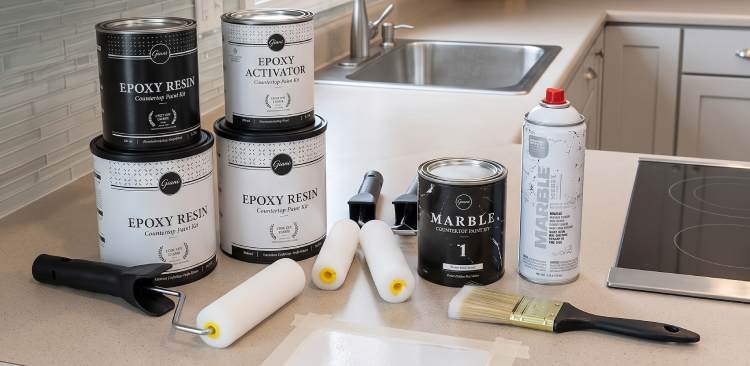
Giani’s strongest advantage is appearance customization.
Many kits are designed specifically to imitate:
- Granite
- Marble
- Quartz
- Butcher block
For granite-style kits, you often apply mineral colors with a sponge.
For marble-style kits, you create veins and highlights before applying the clear epoxy.
That means two homeowners using the same kit can create noticeably different results.
If you enjoy DIY decorative painting, Giani gives you more control over the final pattern.
Which Surfaces Can Rust-Oleum Cover?
This depends on the exact Rust-Oleum system.
Current HOME Countertop Coating can be used on several materials, including:
- Laminate
- Vinyl
- Butcher block
- Concrete
- Porcelain
- Stone
However, older Specialty Countertop Coating has a narrower approved-use list and specifically excludes some stone, tile, and concrete surfaces.
That is why you should not rely on generic advice such as “Rust-Oleum works on every countertop.”
Check the product label.
Which Surfaces Can Giani Cover?
Giani currently lists compatibility with many common countertop materials, including:
- Formica
- Laminate
- Corian
- Butcher block
- Ceramic tile
- Cultured marble
- Traditional granite
- Certain one-piece vanity tops
Some wood surfaces require an additional wood primer before applying the Giani system.
Giani is not intended for:
- Floors
- Showers
- Bathtubs
and submerged applications require extra caution.
Also Read: Is O&N Floating Vanity Worth It?
Key Differences Between Rustoleum And Giani Countertop Paint
If you are keen to know about the basic differentiating points of Rustoleum and Giani countertop paint. Then this section is for you.
So, let’s get started.
- Effect On Heat And Grease
Countertop paint once gets exposed to the heat and grease may start depreciating, especially if the place is inside your kitchen.
So, regardless of the place, you are thinking about having it must be considered if there is any impact on the heat of the atmosphere.
Rustoleum countertop paint has almost no impact in this regard whereas, Giani countertop paint has an impact on it to some extent.
Due to the heat and grease, Giani countertop paint gets tacky and scrapped.
- Regular Use
Rustoleum countertop paint is well suited for regular usage. You can consider it for both bathroom and the kitchen as it takes time to start depreciating for this countertop paint.
On the other hand, Giani countertop paint is not for rough usage. If you intend to do so it would be better to get an epoxy layer above it to ensure durability.
- Finishing
A professional countertop refinishing job is a crucial thing to do and it often takes a professional to do the job.
For Rustoleum countertop paint, the finishing will remain hard after being given enough time to set the job.
But for Giani countertop paint the finish will mostly remain soft and as a result, it is not recommended to keep it wet for a long time.
- Durability
Rustoleum countertop paint is more durable than the other counterpart Giani countertop paint. But to increase the durability of Giani countertop paint you can go for having a layer of epoxy paint above the external surface of the paint.
- Price Differences
It is a very crucial factor to make the ultimate purchase decision. Rustoleum countertop paint is more expensive than Giani countertop paint.
But considering the durability, some users remain ready to spend some extra money.
- Getting Scratch
Giani countertop paint doesn’t get scratched easily on the other hand it is not easy to scratch the Rustoleum countertop paint.
- Look At The Countertop
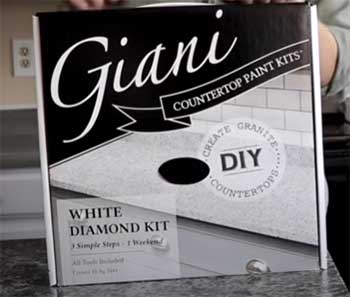
Rustoleum countertop paint looks like granite, on the other hand, Giani’s countertop paint looks like natural stones.
Both the looks perfectly fit the atmosphere of the bathroom and the kitchen.
The makers tried to make both of these to keep the versatility of the overall looks.
So, by now, I hope you are more assured about all the aspects that differentiate the two countertop paint brands
from each other.
Also Read: Is Impressions Vanity Worth It?
Rust-Oleum Pros and Cons
Pros
- Straightforward application
- Excellent solid-color choices
- Satin finish available
- Current HOME system requires minimal prep on approved surfaces
- Good for simple kitchen updates
- Less artistic skill required
- Current systems work on multiple countertop materials
Cons
- Product lines can be confusing
- Some older coatings have narrower surface compatibility
- Less customization for realistic stone effects
- Heat protection still required
- Not scratch-proof
- Final quality depends heavily on prep and rolling technique
Giani Pros and Cons
Pros
- Excellent granite and marble effects
- Many complete kits
- Epoxy topcoat available
- Highly customizable
- Covers many existing countertop materials
- Practice board included with many kits
- Good choice for dramatic transformations
- Repair guidance available
Cons
- More artistic technique required
- Epoxy application needs careful timing
- High gloss can reveal imperfections
- Longer cure period before heavy use
- Heat protection still required
- Faux-stone effect can look artificial if poorly applied
Rust-Oleum Vs. Giani: Which Should You Choose?
Choose Rust-Oleum if:
- You want a solid color.
- You prefer satin over high-gloss epoxy.
- You want the simplest possible application.
- You do not want to create stone patterns manually.
- You like a clean contemporary look.
Choose Giani if:
- You want faux marble or granite.
- You enjoy decorative DIY work.
- You want a high-gloss epoxy finish.
- You want more control over veins and mineral patterns.
- You are willing to spend more time on the artistic stage.
For a simple color transformation, Rust-Oleum makes more sense.
For a dramatic fake-stone makeover, Giani offers more creative flexibility.
Also Read: Is Wyndham Collection Vanity Worth It?
Frequently Asked Questions (FAQ)
Yes, it is a more logical and permanent countertops painting solution, though you may have to spend some more money on it.
Giani countertops paint helps you to get the work done easily and almost hassle-free. By this, you can change the look of your existing countertop in no time.
To do Giani’s countertop painting, it only takes just one weekend most of the time.
Sometimes, it depends. Normally it takes only 6 to 8 hours to completely dry out the first coat. But just to be safe, it is often recommended by the experts to give it a rest for a day.
Yes, this primer would take 8 hours at 70 degrees.
Wrapping Things Up
So now that you know about all the differentiating points of Rustoleum vs. Giani countertop paint, now you can make a better decision regarding which one to consider.
You may find some people getting a better result from either of the two, but considering the majority of the existing reviews, Rustoleum countertop paint seems to be the better alternative than the other one for sure.
Recent Posts
2026 Bathroom Remodel Estimator Bathtub to Shower Conversion Cost Calculator Accurately calculate the true cost of converting your old bathtub into a modern walk-in shower. Estimates acrylic...
I used the Philips Multigroom 5000 for several weeks of beard hair and body grooming while tracking cutting performance battery life ease of cleaning and everyday versatility.You should buy this...