
If you’re comparing RMR-86 vs. Mold Armor, the most important difference is not simply which one removes black mold stains faster.
The two products are marketed for somewhat different jobs.
RMR-86 Instant Mold & Mildew Stain Remover is primarily a fast-acting stain remover. RMR says it can begin removing discoloration caused by mold and mildew in as little as 15 seconds and lists applications ranging from wood and drywall to concrete, tile, grout, vinyl, and fiberglass.
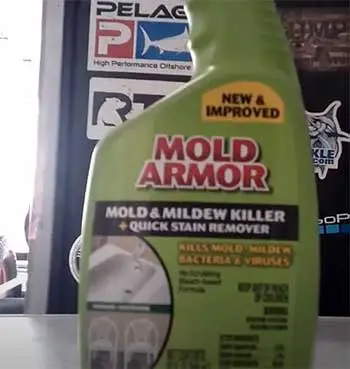
Mold Armor Mold & Mildew Killer + Quick Stain Remover, meanwhile, is an EPA-registered bleach-based cleaner that carries specific claims for killing mold, mildew, bacteria, viruses, and fungi on approved hard, non-porous surfaces. Its label requires 60 seconds of contact time to kill mold and mildew and up to 10 minutes when removing mold and mildew stains.
So the right choice depends on whether your priority is very fast stain removal across a wider range of materials or label-approved mold killing and disinfecting on hard, non-porous surfaces.
A Brief Comparison Table
| Feature | RMR-86 | Mold Armor Mold & Mildew Killer + Quick Stain Remover |
| Main purpose | Mold/mildew stain removal | Mold killing, disinfecting and stain removal |
| Formula type | Bleach-based | Bleach-based |
| Sodium hypochlorite | Less than 5% per SDS | 4% per product label |
| Visible stain action | As little as 15 seconds | Visible results marketed in about 1 minute; stain-removal directions allow 10 minutes |
| Mold-killing claim | Marketed primarily as a stain remover | Yes, on labeled hard non-porous surfaces |
| Disinfectant claims | No comparable disinfectant claim on RMR-86 | Yes |
| Wood/drywall stain removal | Manufacturer lists these surfaces | Quick Stain Remover is primarily labeled for hard non-porous surfaces |
| Sealed grout | Yes | Yes |
| Tile/shower use | Yes | Yes |
| Scrubbing required | Usually no | Usually no |
| Strong bleach odor | Yes | Yes |
| Ventilation required | Strongly recommended | Label specifically requires well-ventilated use |
RMR-86: Fast and Effective Mold Stain Removal
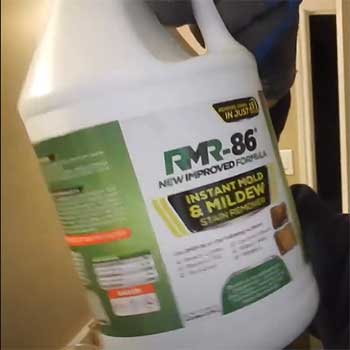
RMR-86 is marketed as a fast-acting mold stain remover.
Its primary selling point is its ability to remove mold and mildew stains within seconds, without the need for scrubbing.
This swift action can be an incredible benefit in time-sensitive situations or when dealing with large areas.
Pros of RMR-86
- Efficiency: RMR-86 takes the crown when it comes to speed. A few sprays can make mold stains vanish in less than a minute.
- Versatility: This product is usable on a variety of surfaces, including wood, concrete, drywall, and more.
- Easy to use: The ready-to-use formula doesn’t need any mixing. Simply spray it onto the affected area.
Cons of RMR-86
- Hazardous ingredients: RMR-86 uses a sodium hypochlorite (bleach) base, which can be harmful if mishandled.
- Odor: The strong chemical smell may be off-putting and requires proper ventilation during application.
- Possible discoloration: The use of bleach may lead to discoloration of certain materials.
Mold Armor: Powerful and Deep Mold Remediation
Mold Armor takes a slightly different approach. While it’s still a spray-and-leave product, it focuses more on deep cleaning, providing a thorough, lasting solution.
Pros of Mold Armor
- Deep Cleaning: Mold Armor penetrates surfaces, killing mold spores at the root.
- Prevents Future Growth: This product doesn’t just remove mold, it also creates a barrier that prevents new spores from developing.
- Multi-purpose: Besides removing mold and mildew, Mold Armor also functions as a disinfectant, killing germs and bacteria.
Cons of Mold Armor
- Longer Contact Time: Unlike RMR-86, Mold Armor requires longer contact time. This could be a downside if you’re in a hurry.
- Limited Usage: Not suitable for porous surfaces like unsealed wood or unsealed grout.
- Strong Chemicals: Similar to RMR-86, Mold Armor contains harsh chemicals and demands proper ventilation.
Key Differences Between RMR-86 and Mold Armor
Although both RMR-86 and Mold Armor are designed to tackle mold issues, they exhibit a few distinct differences. Understanding these key disparities can help you make an informed choice.
- Speed Vs. Depth of Cleaning
RMR-86 is praised for its rapid action. Its claim to fame is the ability to eliminate mold stains in seconds, without the need for scrubbing. This makes it perfect for swift remediation or tackling larger affected areas. The emphasis here is on the speed of the visible mold stain removal.
Mold Armor, on the other hand, focuses on thorough, deep cleaning. While it might not make the stains disappear as instantly as RMR-86, it penetrates surfaces to kill mold spores at the root.
This makes Mold Armor an excellent choice if your priority is to ensure the complete eradication of mold and the prevention of future growth.
- Chemical Composition
Both products contain potent chemicals, which contribute to their effectiveness but also require careful handling.
RMR-86’s main ingredient is sodium hypochlorite (bleach), renowned for its stain-removing abilities. However, the use of bleach may result in discoloration of certain materials.
Additionally, bleach’s strong odor can be off-putting and may necessitate proper ventilation during use.
On the other hand, Mold Armor contains quaternary ammonium compounds, or “quats.” These chemicals are effective at killing mold, bacteria, and other pathogens.
However, similar to RMR-86, Mold Armor also demands proper ventilation due to its strong chemical odor.
- Application and Usage
RMR-86 offers straightforward application — simply spray it onto the affected area without the need for scrubbing. It’s versatile and can be used on a variety of surfaces, including wood, concrete, and drywall.
Mold Armor, while also easy to use, is not suitable for all surfaces. It is not recommended for use on porous surfaces like unsealed wood or unsealed grout.
Ultimately, the choice between RMR-86 and Mold Armor boils down to your specific requirements, the severity of the mold problem, and the type of surfaces involved.
It’s crucial to carefully consider these aspects and follow the safety instructions provided by the manufacturers for effective and safe mold remediation.
RMR-86 Vs. Mold Armor for Bathroom Mold
Bathrooms are one of the strongest use cases for either product, but surface type should determine which instructions you follow.
For hard bathroom surfaces such as glazed tile, shower doors, sealed grout, tubs, and sealed fiberglass, Mold Armor has clear labeled applications.
RMR-86 also lists tile, grout, fiberglass, tubs, toilets, and shower doors among its recommended stain-removal surfaces.
For a small amount of surface mold in a shower, either may remove the visible staining.
But if you specifically want a product with label directions for killing mold on a hard non-porous bathroom surface, Mold Armor provides clearer antimicrobial instructions.
RMR-86 Vs. Mold Armor on Wood
This comparison changes significantly on wood.
RMR specifically markets RMR-86 for mold and mildew stains on wood, decks, and railings, as well as other porous building materials.
The Mold Armor Quick Stain Remover discussed here is primarily labeled for hard, non-porous materials, and its warning says contact with painted wood may cause discoloration or damage.
Mold Armor makes separate outdoor products specifically formulated for decks, fencing, and similar wood surfaces, so don’t assume its bathroom Mold & Mildew Killer is the appropriate Mold Armor product for a wooden deck.
For staining on wood, RMR-86 therefore has the clearer manufacturer-listed application between these two specific products.
But actual mold inside porous wood requires more thought than simply bleaching the visible surface.
What About Mold on Drywall?
RMR-86 lists drywall as one of the surfaces where its stain-removing formula can be used.
However, this is where homeowners should distinguish cosmetic stain treatment from mold remediation.
The EPA notes that mold can penetrate porous or absorbent materials and that some moldy porous materials may need to be discarded because complete cleaning can be difficult or impossible.
If drywall has extensive mold growth, has been repeatedly wet, feels soft, or has contamination inside the wall cavity, spraying the visible face is not necessarily an adequate repair.
Fix the source of moisture first.
Will Either Product Prevent Mold From Coming Back?
Not by itself.
The most important long-term mold treatment is moisture control.
The EPA states that if you clean mold but don’t correct the water problem, mold is likely to return. Bathrooms that repeatedly develop mold often benefit from better ventilation and more frequent drying and cleaning.
Some Mold Armor products are specifically marketed as mold preventers or blockers, and Mold Armor’s Rapid Clean Remediation product has label instructions for repeated treatment to inhibit mold and mildew growth.
But don’t automatically transfer that claim to every Mold Armor product.
Likewise, RMR-86 should not be treated as a substitute for repairing leaks or controlling humidity.
Also Read: Comparison of RMR-86 And Concrobium.
Which Is Better for Black Mold Stains?
Color alone doesn’t tell you what species of mold you’re dealing with, so I wouldn’t use “black mold” as a diagnosis.
If you’re referring simply to dark mold staining, RMR-86 is specifically built around quickly removing those visible stains.
If the affected surface is hard and non-porous and you also want an EPA-labeled mold-killing/disinfecting product, Mold Armor Mold & Mildew Killer + Quick Stain Remover has the clearer label claims.
For a large or recurring mold problem, neither spray should replace proper investigation and remediation.
EPA guidance says that moldy areas of less than roughly 10 square feet can often be handled by homeowners, while larger areas or significant water damage may justify professional remediation.
Safety: Never Mix Either Product With Other Cleaners
This deserves its own section because both formulas involve sodium hypochlorite.
Mold Armor explicitly warns not to mix its product with acids, ammonia, toilet-bowl cleaners, or rust removers, because hazardous gases can be released. Its label also requires use in a well-ventilated area.
RMR-86’s SDS states that contact with acids can release toxic gas and recommends protective gloves, protective clothing, and eye/face protection. It also identifies its odor as chlorine/bleach.
So when using either product, follow the bottle label exactly, protect your eyes and skin, ventilate the area, keep children and pets away during treatment, and never experiment with cleaner combinations.
RMR-86 Vs. Mold Armor: Which Should You Use?
For very fast mold and mildew stain removal, particularly on materials such as wood, concrete, brick, or drywall that RMR specifically lists, RMR-86 has a clear purpose.
For bathroom and other hard, non-porous surfaces where you want both stain removal and a labeled mold-killing/disinfecting action, Mold Armor Mold & Mildew Killer + Quick Stain Remover offers a different advantage.
I wouldn’t choose solely by asking which bottle is “stronger.”
Ask what you’re actually trying to accomplish:
Is there only an old stain? Is active mold present? Is the surface porous or non-porous? Is there still a moisture problem?
Those answers matter more than the brand name.
Frequently Asked Questions (FAQ)
RMR-86 is primarily a mold stain remover. While it does kill surface mold, it’s not as effective at penetrating surfaces to kill mold at the root. For that, you might need a mold killer.
RMR-86’s main ingredient is sodium hypochlorite, the same active ingredient found in bleach. It’s formulated with additional components to enhance its effectiveness against mold and mildew.
The “best” mold removal product largely depends on your specific needs. For quick stain removal, RMR-86 is a great choice. For deeper cleaning and mold prevention, Mold Armor has proven to be very effective.
Both RMR-86 and Mold Armor can be effective at removing mold stains from drywall. However, if the mold has penetrated deeply, it may be necessary to replace the drywall or consult a professional mold remediation service. Always remember that safety comes first when dealing with mold.
Final Thoughts
The RMR-86 and Mold Armor comparison becomes much easier once you stop treating them as identical mold sprays.
RMR-86 is primarily designed to make stubborn mold and mildew staining disappear quickly, with the manufacturer advertising results in as little as 15 seconds and listing applications ranging from drywall and wood to concrete and tile.
Mold Armor Mold & Mildew Killer + Quick Stain Remover is also bleach-based, but it adds specific mold-killing, sanitizing, disinfecting, and fungicidal claims for approved hard, non-porous surfaces.
Neither product fixes the reason mold grew in the first place.
If mold repeatedly returns, find and correct the leak, condensation, ventilation, or humidity problem. For extensive mold or major water damage, proper remediation matters far more than which spray removes the visible stain fastest.
Recent Posts
2026 Bathroom Remodel Estimator Bathtub to Shower Conversion Cost Calculator Accurately calculate the true cost of converting your old bathtub into a modern walk-in shower. Estimates acrylic...
I used the Philips Multigroom 5000 for several weeks of beard hair and body grooming while tracking cutting performance battery life ease of cleaning and everyday versatility.You should buy this...