
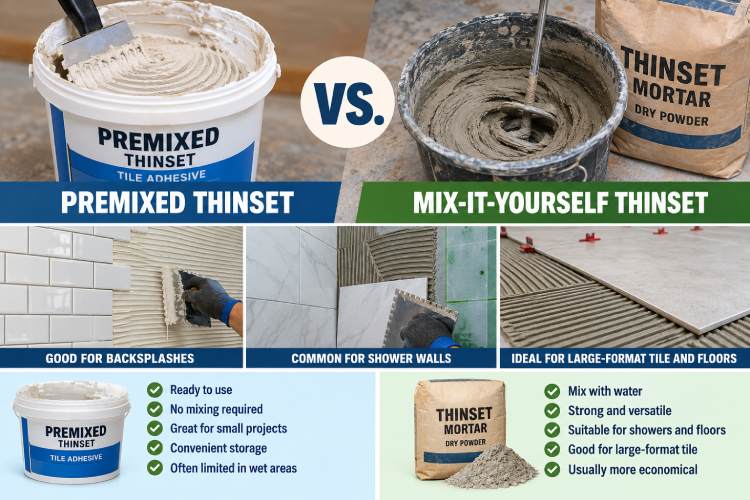
The biggest surprise in the premixed thinset vs. mix-it-yourself debate is that most traditional “premixed thinset” sold in buckets isn’t actually the same material as powdered cement-based thinset mortar.
Premixed products are convenient for small, simple tile jobs. Powder mortar takes more work but is usually the stronger and more versatile option—especially for showers, waterproof membranes, large-format tile, and demanding floors.
A Quick Comparison Table
| Feature | Premixed Tile Adhesive | Mix-It-Yourself Thinset |
| Ready to use | Yes | No |
| Requires water | No | Usually |
| Mixing drill needed | No | Recommended |
| Main cure method | Drying/chemical cure, product-dependent | Cement hydration |
| Small wall tile | Excellent application | Yes |
| Large-format tile | Often limited | Many suitable products |
| Shower walls | Product-dependent | Commonly suitable |
| Shower floors | Often unsuitable | Suitable with correct mortar |
| Waterproof membranes | Often restricted | Commonly used when specified |
| Exterior tile | Usually no | Many products available |
| Submerged areas | Usually no | Specialized mortars available |
| Working convenience | Excellent | More preparation |
| Leftovers | Bucket can often be resealed | Mixed batch must be used/discarded |
| Cost for large projects | Usually higher | Usually more economical |
| Best for | Small interior projects | Most serious tile installations |
Differences Between Premixed Thinset and Mix-It-Yourself
Let’s see how they are different from each other:
The Biggest Difference: How They Harden

This is the practical reason premixed adhesive has more limitations.
Traditional Thinset
Cement-based thinset hardens primarily through hydration.
The cement reacts chemically with water.
That means it doesn’t simply need all of its moisture to evaporate through the tile or substrate before it can gain strength.
Traditional Premixed Adhesive
Many ready-to-use tile adhesives depend much more heavily on drying.
That becomes problematic when adhesive is trapped between two materials that allow very little moisture movement.
Examples include:
- Large porcelain tile
- Waterproof membranes
- Very dense substrates
The outside of the adhesive may appear firm while material deeper beneath the tile remains soft for much longer.
Premixed Thinset Is Much Easier to Use
Convenience is its biggest advantage.
Open the bucket and begin installing.
You don’t need:
- Mixing drill
- Paddle
- Measuring bucket
- Water measurement
- Slake time
- Dusty powder
For a beginner installing a small backsplash, that convenience can be valuable.
When you’re finished, many products can simply be resealed for later use.
With traditional mortar, once you mix a batch, the clock starts.
Powder Thinset Requires Proper Mixing
Powder mortar isn’t difficult to mix, but technique matters.
A typical process involves:
- Measure the correct amount of clean water.
- Add mortar powder.
- Mix with an appropriate drill and paddle.
- Allow the material to slake if required.
- Remix without adding extra water.
- Use within the stated pot life.
Exact instructions vary.
Adding too much water can negatively affect mortar performance.
And once cement mortar begins hardening in the bucket, you shouldn’t keep adding water to make it workable again.
Which Is Better for Backsplashes?
This is one of the strongest applications for ready-to-use adhesive.
For a small ceramic kitchen backsplash on an approved interior substrate, premixed adhesive can be extremely convenient.
Advantages include:
- No mixing
- Good initial grab
- Minimal cleanup
- Easy application
- Easy storage between sessions
However, tile size and material still matter.
A bucket adhesive approved for small ceramic tiles may have significant limitations with large porcelain or natural-stone tiles.
Always check the specific product rather than assuming every backsplash qualifies.
Which Is Better for Shower Walls?

This is where the answer becomes more complicated.
Some premixed Type I adhesives are approved for intermittently wet shower or tub-surround walls.
For example, some manufacturers specifically allow certain ready-to-use adhesives on suitable shower walls while prohibiting them on shower floors or in continuously wet environments.
But that does not mean premixed adhesive is universally suitable for showers.
The waterproofing system also matters.
Premixed Adhesive Over Waterproofing Membranes
This is one of the biggest reasons I prefer powdered mortar for modern showers.
Many shower systems use waterproof membranes immediately behind the tile.
Traditional premixed mastics can have trouble drying when trapped between:
- Dense porcelain tile
- Impermeable waterproof membrane
Some manufacturers explicitly prohibit their conventional premixed adhesive over waterproof membranes.
Schluter, for example, says premixed thinset/mastic should not be used to install KERDI or tile in a KERDI shower.
For these assemblies, use the mortar required by the waterproofing-system manufacturer.
Which Is Better for Shower Floors?
For a conventional premixed mastic-type product, powder mortar is the clear choice.
Many ready-to-use adhesives specifically prohibit:
- Shower floors
- Constantly wet areas
- Submerged installations
- Steam environments
Custom’s SimpleSet, for example, is not approved for shower floors, prolonged water exposure, or steam.
Use a cement-based or other specifically approved mortar that matches your shower system.
What About Newer Premixed Mortars?
There is an important exception.
Not every modern ready-to-use product is old-fashioned mastic.
Newer products are appearing that use different technology and meet performance standards historically associated with high-performance cement mortars.
For example, LATICRETE’s MULTIMAX 1 is a premixed adhesive mortar that the manufacturer rates for:
- Wet areas
- Waterproof membranes
- Large and heavy tile
- Submerged applications
It meets standards including ANSI A118.15 and A118.11.
So the rule is no longer:
All premixed products are mastic and should never be used in wet areas.
Instead:
Read the technical data for the exact product.
Traditional bucket mastic and newer high-performance premixed mortar are not interchangeable.
Which Is Better for Large-Format Tile?
Powder mortar is usually the more practical choice.
Large-format tiles create several challenges:
- Greater need for mortar coverage
- Longer drying for premixed adhesive
- Tile weight
- Flatness requirements
- Need for mortar capable of supporting heavy tile
Modern large-and-heavy-tile mortars are specifically formulated for these installations.
Traditional premixed adhesive can have strict tile-size limits.
For example, SimpleSet recommends tiles up to 8 × 8 inches, although tiles with one side up to 15 inches may be allowed with significantly longer drying time.
Check your tile and mortar specifications before installing a 12 × 24 or 24 × 48 tile with anything from a premixed bucket.
Which Is Better for Porcelain?
Porcelain is extremely dense.
That makes proper adhesive selection particularly important.
Small porcelain tile may be approved with some premixed products.
Large porcelain combined with a nonporous substrate can dramatically increase drying time for traditional premixed adhesive.
A high-quality cement-based mortar rated for porcelain is usually the easier choice to specify correctly.
Which Is Better for Floors?
Powder mortar wins for most tile floors.
Some premixed adhesives can technically be used on approved floors with small tiles, but their limitations may be restrictive.
For example, some traditional mastics limit floor tiles to around 6 × 6 inches.
Modern tile floors commonly use:
- 12 × 24 porcelain
- Large stone
- Uncoupling membranes
- Heated-floor systems
These applications generally favor properly selected powdered mortar.
Can You Use Premixed Thinset Under Cement Board?
Usually not if you’re talking about conventional ready-to-use tile adhesive.
Cement backer board installed over a wood subfloor typically requires the specific mortar identified by the backer-board manufacturer beneath the panel.
Some premixed adhesives explicitly prohibit use for installing backer board.
The mortar underneath cement board isn’t there primarily to glue the board to the floor.
It fills voids and provides continuous support.
Use the product specified by the board manufacturer.
Can You Use Premixed Thinset With DITRA or KERDI?
Do not assume so.
Membrane manufacturers specify compatible bonding mortars based on:
- Membrane design
- Substrate
- Tile
- Mortar chemistry
Schluter currently specifies appropriate Schluter mortars or suitable thinset mortar for KERDI rather than conventional premixed mastic.
The same principle applies to any membrane system:
Follow the membrane manufacturer’s mortar requirement, not the adhesive bucket’s marketing name.
Drying and Curing Time
Premixed products often become less attractive as tile size increases.
Larger tiles cover more adhesive and leave fewer pathways for moisture to escape.
Drying can therefore take considerably longer.
Manufacturers specifically warn that tile size, substrate porosity, humidity, and temperature can all change drying time.
Cement mortar also needs adequate cure time, but it isn’t relying solely on evaporation in the same way.
Which Gives You More Working Time?
It depends on the product.
Premixed adhesive is convenient because material remaining inside the bucket can often stay usable when properly resealed.
Cement mortar has a defined:
- Pot life
- Open time
Once mixed, it needs to be used within that period.
However, you shouldn’t confuse bucket life with open time.
Whether using premixed adhesive or mortar, don’t spread a huge area and then place tile onto adhesive that has already skinned over.
Which Is Cheaper?
For larger projects, powdered thinset is usually more economical.
A bag can cover substantial floor or wall area at a relatively modest material cost.
Premixed adhesive charges a premium for:
- Convenience
- Factory consistency
- Resealable packaging
- No mixing equipment
For a 20-square-foot backsplash, the price difference may not matter.
For hundreds of square feet of flooring, it can matter considerably.
Premixed Vs. Powder Thinset: Which Should You Choose?
Choose a traditional premixed tile adhesive when:
- You’re doing a small interior project.
- The exact product approves your tile and substrate.
- You’re installing relatively small tile.
- The area is dry or only intermittently wet as permitted.
- Convenience matters more than material cost.
Choose mix-it-yourself cement mortar when:
- You’re building a tiled shower.
- You’re installing a shower floor.
- You’re using a waterproof membrane.
- You’re setting large-format tile.
- You’re installing porcelain floors.
- You’re working outdoors.
- You’re installing over an uncoupling membrane.
- You need a specialized high-performance mortar.
And remember that newer high-performance premixed mortars can break some of these traditional rules—so always judge the product by its technical specifications, not simply by whether it comes in a bucket.
Final Words
I hope my detailed article has helped you to know the difference between Premixed Thinset Vs. Mix-It-Yourself on your preferred locations. Both have their pros and cons so the decision is up to you
Nevertheless, if you are a DIY enthusiastic you may prefer mixing things on your own and if you want something readymade then there is always an option for premixed thin-set.
Recent Posts
I used the L'Oreal Elvive Dream Lengths shampoo conditioner and leave-in cream for several weeks on long heat-styled hair while tracking softness detangling and end condition.You should buy...
I used Fix Your Lid Styling Fiber every day for several weeks on short textured hair while tracking hold texture finish and real all-day performance.You should buy Fix Your Lid Styling Fiber when...