
Nuance shower boards are designed as a waterproof wall-panel system, but they can still fail if the wall is uneven, joints are poorly sealed, the wrong adhesive is used, cut-outs are too tight, or movement is ignored.
Most Nuance shower boards problems are installation-related rather than problems with the panel core itself.
Here are the issues worth knowing before or after installation.
Nuance Shower Boards Problems At a Glance
| Problem | Likely Cause | What to Check First |
| Water behind panel | Failed sealant or joint | Corners and base |
| Panel lifting from wall | Poor adhesive bond | Wall flatness and adhesive |
| Visible gaps at joints | Poor fitting or movement | Joint spacing |
| Cracked acrylic panel | Incorrect drilling/cutting | Cut-out corners |
| Chipped edges | Poor blade or unsupported cutting | Cut quality |
| Water at base | Incomplete bottom seal | Tray/floor junction |
| Panel feels hollow | Uneven wall or weak adhesive contact | Substrate flatness |
| Pattern mismatch | Panels not planned before cutting | Dry layout |
| Sealant keeps failing | Movement or poor preparation | Joint condition |
| Scratches | Abrasive cleaning | Cleaner and cloth |
| Accessories pull loose | No solid fixing behind panel | Wall fixing points |
| Warranty concern | Wrong adhesive/sealant | Installation materials |
1. Failed Sealant Can Let Water Behind the Panels
This is probably the most important failure point.
Nuance panels themselves can be waterproof, but water can still get behind them through poorly sealed:
- Vertical joints
- Internal corners
- Bottom edges
- Pipe penetrations
- Shower-tray junctions
The system relies heavily on the specified sealant at these transitions.
If the sealant:
- Pulls away
- Cracks
- Was applied too thinly
- Doesn’t fully fill the joint
water can bypass the face of the panel.
What to Look For
Check for:
- Gaps
- Dark staining
- Soft sealant
- Separation at corners
- Water appearing from the panel base
A waterproof panel with a failed joint is still a leaking shower system.
Also Read: Differences Between Premixed Thinset And Mix-It-Yourself.
2. The Bottom Edge Must Be Sealed Correctly
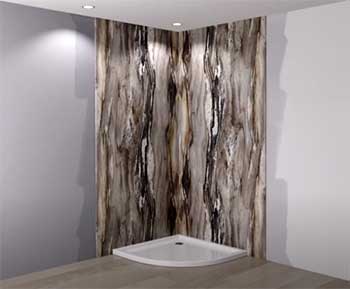
Nuance installation details call for a deliberate gap between the bottom of the panel and the shower tray, bath, or finished floor.
That gap is then filled with the specified sealant.
This is not a mistake or unfinished detail.
It allows the joint to be properly sealed rather than simply resting the panel tightly on the tray.
If the installer leaves voids at the bottom, water can work behind the board.
This is especially important in wet-room installations.
3. Uneven Walls Can Cause Adhesive Failure
Nuance panels need a sound, flat substrate.
They can be installed over suitable:
- Plasterboard
- Existing tile
- Other sound wall surfaces
but the wall must be:
- Clean
- Dry
- Stable
- Flat
- Plumb
A wall with deep dips can prevent the adhesive from contacting the panel properly.
That can leave hollow areas or cause the panel to flex.
Symptoms
- Panel sounds hollow
- Panel bows when pressed
- Joint opens slightly
- Edge starts pulling away
The panel may be waterproof, but poor support can still compromise the installation.
4. Using the Wrong Adhesive Can Cause Problems
Bushboard specifies its own Complete adhesive for Nuance installations.
That matters for both performance and warranty requirements.
Using an unrelated grab adhesive may create problems such as:
- Poor bond
- Uneven curing
- Chemical incompatibility
- Panel movement
The adhesive bead pattern also matters.
Too little adhesive can leave unsupported sections.
Too much in random blobs can make the panel difficult to seat evenly.
Also Read: Differences Between KBRS And Kerdi Shower Pans.
5. Tongue-and-Groove Joints Can Leak If Not Sealed
Nuance tongue-and-groove panels are designed to create neat connections.
But the joint itself still needs the specified sealant.
The tongue and groove should not simply be pushed together dry.
Sealant is used within the joint so that the connection remains watertight.
If the installer:
- Skips sealant
- Leaves part of the tongue dry
- Fails to seat the joint fully
water may travel behind the connection.
6. Expansion Gaps Matter
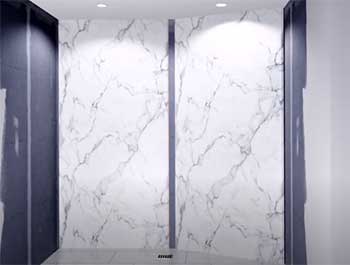
Panels need room for small amounts of movement.
Nuance installation instructions specify gaps at various junctions rather than forcing the boards tightly into every corner.
These spaces are then properly sealed.
If panels are fitted too tightly, movement can create stress at:
- Corners
- Joints
- Pipe openings
- Base edges
This can eventually lead to visible gaps or sealant failure.
The goal is not zero gap.
The goal is a correctly sized, sealed joint.
7. Acrylic Nuance Panels Can Crack Around Cut-Outs
Acrylic panels need extra care during drilling and cutting.
Cracks can start around:
- Shower valves
- Pipe holes
- Electrical openings
- Access cut-outs
Sharp square corners are especially risky.
Bushboard’s acrylic instructions specify rounded cut-out corners rather than creating sharp 90-degree internal corners.
Why?
Because sharp corners concentrate stress.
A small crack can then spread from the corner of the opening.
Also Read: Differences Between Vevor And Schluter Waterproofing Systems.
8. Drilling Acrylic Incorrectly Can Chip or Shatter It
Standard drilling technique can damage acrylic if the panel is unsupported or drilled too aggressively.
Potential problems include:
- Chipped holes
- Star cracks
- Shattered edges
The panel should be supported while drilling.
Slow drilling and appropriate drill geometry help reduce damage.
For some holes, drilling partway from one face and completing the hole from the other can reduce breakout.
9. Cutting Can Leave Chipped or Rough Edges
WPC-style Nuance panels are relatively easy to cut using woodworking tools.
But poor cutting technique can still produce:
- Chipped decorative surface
- Ragged edges
- Uneven joints
A sharp blade is essential.
For visible edges, finishing quality matters because even a waterproof panel can look poor if the edge is badly cut.
Acrylic panels demand even more careful cutting.
10. Pattern Matching May Not Be Perfect
This is more of a visual complaint than a failure.
Decorative panels can have:
- Stone effects
- Tile effects
- Large-scale patterns
Tongue-and-groove designs are not always intended to create a continuous pattern across every joint.
If the installer expects perfect continuity without planning the layout first, the finished wall can look mismatched.
Before Cutting
Dry-fit the panels and check:
- Horizontal lines
- Pattern direction
- Joint location
- Corner transitions
This is especially important with large geometric or tile-style designs.
11. Panels Can Scratch During Cleaning
Nuance is designed for easy maintenance, but that does not mean you should use aggressive abrasives.
Avoid:
- Scouring pads
- Steel wool
- Abrasive powders
- Harsh scraping tools
Use a non-abrasive bathroom cleaner and soft cloth.
Glossy acrylic finishes in particular can show scratching more clearly.
A cleaner surface is not worth permanently dulling the finish.
Also Read: Is VEVOR Shower Kit Worth It?
12. Limescale and Soap Film Can Build Up
Even waterproof wall panels still require cleaning.
In hard-water areas, you may see:
- White scale
- Water spots
- Soap scum
- Dull patches
Regular cleaning is easier than allowing heavy buildup to develop.
Use a mild, non-abrasive cleaner and rinse away residue.
The waterproof panel itself may be fine even when the surface looks cloudy from mineral deposits.
13. Accessories Need Proper Support
Do not rely on the wall panel alone to support heavy items.
Fixtures such as:
- Shower screens
- Grab rails
- Large shelves
- Heavy shower hardware
should transfer their load into a solid fixing point behind the panel.
If heavy accessories are mounted only through the panel skin, you risk:
- Movement
- Cracking
- Loose hardware
- Broken seal around fixing
Plan reinforcement before installing the boards.
14. Pipe and Fitting Cut-Outs Need Clearance
Cut-outs should not fit tightly around pipes or fittings.
A small clearance is intentionally left around penetrations and then filled with sealant.
This gives room for:
- Installation tolerance
- Small movement
- Complete waterproof sealing
If the hole is cut too tight, movement can stress the panel.
If it is cut too large and poorly sealed, water can get behind the wall.
15. Panels Installed Over Tiles Need Proper Preparation
Nuance can be installed over existing tiles if they are:
- Secure
- Smooth enough
- Clean
- Sound
But existing sealant should be removed and the tiled surface needs adequate preparation for adhesion.
Bonding a new panel directly over:
- Loose tile
- Grease
- Soap film
- Failing old silicone
is asking for trouble.
The finished panel is only as stable as the surface underneath it.
16. Water Behind a Nuance Panel Does Not Necessarily Mean the Panel Failed
This is an important distinction.
If water reaches the cavity behind the wall panel, likely causes include:
- Poor joint seal
- Incomplete base seal
- Unsealed pipe penetration
- Plumbing leak
- Incorrect installation
The panel core itself may still be unaffected.
That is very different from gypsum-based wallboard swelling because the material itself absorbed water.
17. Sealant Maintenance Is Still Required
A 15-year waterproof guarantee does not mean the shower can be ignored for 15 years.
Sealant joints are service points.
Inspect periodically around:
- Tray
- Bath
- Corners
- Pipe openings
- Shower screens
If sealant starts separating, repair it before water reaches the wall behind.
A small maintenance job is much cheaper than opening an entire shower wall.
Also Read: Differences Between Water-Resistant Drywall And Cement Board.
Nuance Shower Boards Pros and Cons
Pros
- Waterproof core/system
- No traditional grout lines
- Fast installation compared with tile
- Can install over suitable existing tiles
- Large panel sizes
- Easy routine cleaning
- Many decorative finishes
- 15-year waterproof guarantee when correctly installed and maintained
Cons
- Installation details are critical
- Sealant joints require maintenance
- Poor wall preparation can cause hollow areas
- Cutting mistakes are visible
- Acrylic panels can crack if drilled incorrectly
- Pattern alignment requires planning
- Heavy fixtures need solid backing
- Wrong adhesive can affect performance and guarantee
How to Avoid Nuance Shower Board Problems
Before installation:
- Make sure walls are flat and dry.
- Remove old sealant.
- Repair loose tiles.
- Dry-fit panels.
- Plan patterns and joints.
During installation:
- Use specified adhesive.
- Keep required gaps.
- Seal tongue-and-groove joints completely.
- Seal every pipe penetration.
- Fully seal the base.
- Support acrylic while drilling.
After installation:
- Allow adhesive/sealant to cure properly.
- Inspect joints periodically.
- Use non-abrasive cleaners.
- Repair damaged sealant quickly.
Final Thoughts
Most Nuance shower boards problems come down to installation and sealing rather than the waterproof panel core itself.
The critical areas are the bottom joint, corners, tongue-and-groove seams, pipe cut-outs, adhesive bond, and wall preparation.
Install the panels on a flat, dry substrate, use the specified adhesive and sealant, leave the required clearances, and support acrylic properly while cutting.
Done correctly, Nuance can provide a waterproof, grout-free shower finish.
Done poorly, even a waterproof board can let water reach the wall through its joints.
One thought on “Nuance Shower Boards Problems With Effective Solution”
Leave a Reply
Recent Posts
2026 Bathroom Remodel Estimator Bathtub to Shower Conversion Cost Calculator Accurately calculate the true cost of converting your old bathtub into a modern walk-in shower. Estimates acrylic...
I used the Philips Multigroom 5000 for several weeks of beard hair and body grooming while tracking cutting performance battery life ease of cleaning and everyday versatility.You should buy this...
I am comparing the Nuance shower wall against the Fibo brand. Your article has helped me see potential problems that I was concerned about due to the way they are attached using only adhesive. If you have any comments about Fibo, please let me know. I would like to hear your opinion.
Thank you for your time.