
If your property has enough downhill elevation to discharge foundation water safely, I prefer a gravity drain over a sump pump.
Gravity drainage works without electricity, switches, batteries, or motors. A sump pump is the better—and sometimes only—choice when the basement sits too low for water to flow naturally to an approved outlet.
The key is elevation, not personal preference.
A Brief Comparison Table
| Feature | Gravity Drain | Sump Pump |
| Requires Electricity | No | Usually yes |
| Moving Parts | None | Pump, motor, float/sensor |
| Power-Outage Risk | No | Yes |
| Battery Backup Needed | No | Strongly recommended in higher-risk homes |
| Maintenance | Low | Moderate |
| Noise | None | Some |
| Can Move Water Uphill | No | Yes |
| Best For | Sloped sites with a lower outlet | Flat/low sites |
| Mechanical Failure Risk | Very low | Higher |
| Installation Difficulty | Site dependent | Usually more flexible |
| Operating Cost | Essentially none | Electricity + maintenance |
| Drainage Capacity | Depends on pipe/slope/outlet | Depends on pump flow and head |
| Long-Term Simplicity | Excellent | Good with maintenance |
| Main Weakness | Requires suitable elevation | Depends on mechanical equipment |
Key Differences Between Gravity Drain And Sump Pump Water Draining Systems
- Best To Use For
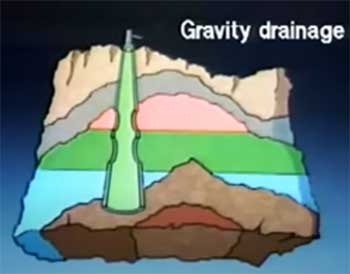
There is nothing wrong with saying that both systems are designed to remove or drain that flooded water from the most drowning part of your house.
The basement of your house has more water if your house has been highly affected by the recent flood.
In that case, consider using a Sump Pump. It’s the first and primary way of removing that water from a place like that.
When you don’t have enough support, a sump pump will force water out of the basement. And along with the water, the debris, mold, and other particles will also be removed.
However, sometimes, you might get too disturbed because of the extra noise, needed power, and other complications with the sump pump.
It makes you turn towards using a Gravity drain system.
It’s the best alternative that works quietly and doesn’t require a power source or an additional generator.
Hence, both are important for draining that extra water stored in the lower part of your house.
- Electricity Required?
A sump pump cannot work without a continuous power source. Suppose the electricity cuts down due to an emergency or the pump stops working. In that case, you will have to have an alternative generator.
Without a generator or electricity, it will be ineffective at draining water from that specific location. But with the Gravity drain, you won’t need any power connectivity.
It will work according to the laws of physics and will keep working even if there is no electricity in the rest of your living space.
- Makes Noise
If you are familiar with the working of a water pump, you might actually know how much noise it can make.
That’s the case with a long-term used water-draining Sump Pump. If you are using an old one, it will keep making much noise and will always require a kick-start when it turns off.
Sometimes, this situation bothers most of us; at that moment, using the alternative is the best decision.
With the gravity drain water system, you will find zero noise, even if it works at its best in removing that water. It will let you know when all the water will be out of the basement or wherever you have applied it.
- Force Usage To Remove Water
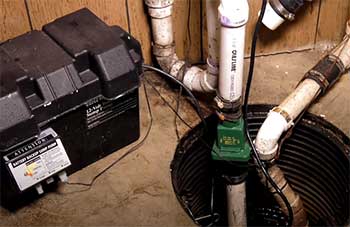
A Sump Pump always uses additional force to pump water from the lowest positions.
It also removes the room’s remaining mild mold, debris, and other stuff.
This stuff would otherwise come in the basement with water.
The force is applied at a greater level, so everything should be removed ideally.
However, a Gravity system works smoother and calmer. It is installed in a very smooth and polite way.
It will not bother you, but it still will remove all the water from that specific location!
- Maintenance Required
What will you do if your sum pump gets down?
It will require instant maintenance and recovery, so it must start operating soon. In that case, it might cost you some extra operating costs.
However, there will be no maintenance required for a Gravity drain. It’s just a one-time installation, and it will keep working without triggering any problems.
- Cost Factor
A Sump Pump will cost you more money in terms of buying it, fixing it, and running it on a direct source of electricity or battery-powered.
That’s why the system is a bit more expensive than the Gravity Drain system.
Because in gravity, you will not have to spend much in terms of anything.
- Flow Rate
The flow rate with the Gravity Drain is so smooth that it will keep draining water out at a constant speed. Therefore, it provides the best water flow without any disturbance.
However, you may not enjoy it with the pump because if it stops working due to any reason, the flow rate will be disturbed.
Also Read: Comparison of Wayne And Ridgid Sump Pumps.
Is Gravity Drainage Better Than A Sump Pump?
If both are physically possible?
In most cases:
yes.
Gravity has a major reliability advantage.
There is no:
- Motor
- Electrical supply
- Float switch
- Battery charger
- Check valve cycling
- Pump impeller
to depend on.
That is difficult to beat.
Why Is Gravity So Reliable?
Because the driving force is constant.
As long as:
- The pipe remains open
- The slope remains intact
- The outlet is unobstructed
water flows.
There is no startup event.
Nothing has to detect the water first.
Nothing has to switch on.
Can A Gravity Drain Fail?
Absolutely.
“Gravity” does not mean maintenance-free forever.
Problems can include:
- Sediment
- Roots
- Collapsed pipe
- Crushed pipe
- Ice
- Animal nests
- Blocked outlet
- Improper slope
- Soil movement
A poorly designed gravity drain can perform worse than a good sump system.
How Much Slope Does A Gravity Drain Need?
This depends on the type of drainage and local code.
The most important requirement is a continuous downward path.
There should be no low spots that trap water.
For conventional gravity drainage piping, a slight but continuous grade is usually enough.
The exact required pitch depends on:
- Pipe type
- Diameter
- Drainage function
- Local building code
I would have the installer verify the required slope for the specific system rather than choosing an arbitrary number.
Is More Slope Always Better?
Not necessarily.
Once you have adequate continuous fall, excessive slope is usually unnecessary.
The more important issue is avoiding:
- Reverse slope
- Bellies
- High spots
that prevent free drainage.
Who Should Choose A Gravity Drain?
I would choose gravity if:
- My house is on a slope.
- I have a safe lower discharge point.
- The drain can maintain continuous fall.
- Local regulations allow it.
- The outlet cannot easily become submerged.
- I am building new construction and can design it correctly.
Who Should Choose A Sump Pump?
I would choose a sump if:
- My basement is lower than the surrounding discharge points.
- My lot is flat.
- A gravity outlet would require impossible excavation.
- I need an interior basement drainage retrofit.
- Groundwater must be lifted before it can leave the property.
Frequently Asked Questions (FAQ)
A gravity drain system works on gravity’s base and safely drains water from your basement. It is usually installed in the basement, having a line pitched downhill.
If you are happy with your drain system, be on it. There is no need for a Sump Pump and spending additional money.
A Gravity Fed Sump Pump works by pulling water from one location and pouring it into another using the force of gravity. It is commonly used to pump water from basements or lower building levels into the ground.
If more noise, electricity consumption, and stoppings in workings bother you, using a French drain is better than a Sump Pump.
Final Wording
If you take my suggestions, having a Gravity drain is always better because you stay unnoticed with it, and it helps you remove all the water from the basement. Therefore, I would like to go with the Drain system in comparing the gravity drain vs. the sump pump.
But if you already have an excellent working sump pump, don’t lose it, as it works best and faster in removing that stored or unwanted water.
Recent Posts
2026 Bathroom Remodel Estimator Bathtub to Shower Conversion Cost Calculator Accurately calculate the true cost of converting your old bathtub into a modern walk-in shower. Estimates acrylic...
I used the Philips Multigroom 5000 for several weeks of beard hair and body grooming while tracking cutting performance battery life ease of cleaning and everyday versatility.You should buy this...