
If you are planning a bathroom renovation in 2026, the battle of RedGard vs. AquaDefense is likely at the forefront of your mind.
I have spent years applying these liquid membranes to shower walls and floors to determine which one offers the most reliable seal against moisture.
In this article, I will analyze the performance, drying times, and application nuances of both products to help you choose the right barrier for your tile project.
You should realize that while both are industry staples, their chemical behaviors and curing speeds can drastically change your installation timeline.
Comparison Overview: RedGard Vs. AquaDefense
| Feature | Custom RedGard | Mapei AquaDefense |
| Color (Wet/Dry) | Pink to Dark Red | Teal to Blue/Green |
| Drying Time | 1-2 Hours per coat | 30-50 Minutes per coat |
| Flood Test Ready | 24 Hours | 12 Hours |
| Odor Level | Moderate (Ammonia-like) | Very Low |
| Thickness (Cured) | 30-35 Mils (Walls) | 20 Mils (Approx. credit card) |
| Consistency | Thicker, Paste-like | Thinner, More Fluid |
| Substrates | Concrete, Cement Board, OSB | Concrete, Cement Board, Plywood |
My First-Hand Experience with Liquid Waterproofing
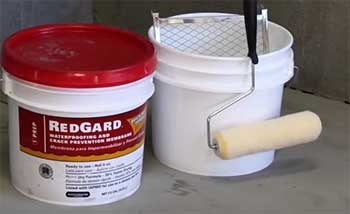
I remember the first time I cracked open a bucket of RedGard.
I am a person who likes a clear visual indicator, and I noticed immediately that the bright pink-to-red color change is a lifesaver for identifying thin spots.
I found that the consistency is quite thick, almost like a heavy pudding, which I realized makes it excellent for filling small gaps in cement board seams.
I eventually learned, however, that you have to be patient with it.
I noticed that if I rushed the second coat, the bottom layer would “re-emulsify,” leading to a messy, sticky situation that took even longer to dry.
I eventually switched to Mapei AquaDefense for a high-priority job where the homeowner wanted the shower tiled and finished in a single weekend.
I realized immediately that AquaDefense is a different animal.
I found that it flows much more like a traditional heavy paint, which I noticed made the rolling process significantly faster and less taxing on my arms.
I am someone who works in tight, poorly ventilated bathrooms often, and I noticed that the lack of odor in AquaDefense was a massive relief compared to the sharp ammonia scent of RedGard.
I eventually found myself in a situation where I needed to perform a flood test on a Saturday evening.
I noticed that with AquaDefense, I could fill the pan just 12 hours after my last coat, whereas with RedGard, I had to wait a full day.
I realized that if I were on a strict professional deadline, the Mapei product would be my go-to choice.
On the other hand, I found that for a DIYer who wants to “see” their progress, the dramatic color shift of RedGard provides a psychological safety net that is hard to beat.
I finished my comparison realizing that both products do exactly what they promise—they create a rubberized, waterproof skin.
I eventually noticed that my long-term results were identical with both; neither shower has leaked a drop in five years.
I realized that the “better” product depends entirely on your pace of work and how much you value a quick turnaround versus a visual guide.
I found that once the tile is up, the “red vs. blue” debate disappears, but the peace of mind stays.
Maintenance Tips for a Watertight Shower
- Always Perform a Flood Test Before Tiling: You should realize that even a “perfect” looking coat can have a microscopic pinhole. Filling the shower pan with water for 12 to 24 hours is a vital maintenance tip for long-term success, which I found prevents thousands of dollars in subfloor rot.
- Use Mesh Tape at Every Corner: You should notice that corners are where buildings move and settle. Embedding alkali-resistant mesh into your first coat is a key maintenance tip for stability, which results in a membrane that won’t tear when the house shifts.
- Clean Your Substrate of All Dust: You should realize that liquid membranes cannot bond to a “dusty” wall. Vacuuming and wiping down your cement board with a damp sponge is a smart maintenance tip for adhesion, which I found prevents the membrane from peeling like a sunburn later.
- Apply Two Coats in Opposite Directions: You should notice that rolling the first coat vertically and the second coat horizontally is the best way to ensure full coverage. This “cross-hatching” is an essential maintenance tip for integrity, which provides a seamless skin that covers every pore.
- Check the Expiration Date on the Bucket: You should realize that these liquid rubbers have a shelf life. Using a “fresh” bucket that hasn’t sat in a freezing garage is a great maintenance tip for efficacy, which I found ensures the chemicals react and cure correctly.
- Never Dilute the Product with Water: You should notice that watering down RedGard or AquaDefense to make it “go further” ruins its waterproofing properties. Using the product straight from the bucket is a crucial maintenance tip for safety, which results in a layer that actually meets its ASTM ratings.
Pros and Cons of RedGard: The visual standard
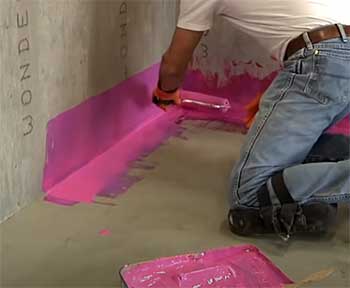
Pros of RedGard: The visual standard
- Visual Color-Change Indicator: It features a bright pink hue when wet that turns into a deep, dark red once cured: I found this to be the most critical feature for ensuring even coverage: this results in a foolproof way to spot pinholes or missed areas: I noticed that I could easily see where I needed a third “insurance” coat.
- Superior Crack Isolation: It utilizes an elastomeric formula that can bridge non-structural cracks up to 1/8 inch: I found this incredibly helpful for older homes with slight settling: this provides a flexible layer that prevents tile grout from cracking: I noticed it acts as a shock absorber between the substrate and the tile.
- Heavy-Duty Consistency: It features a high-solids, thick texture that stays where you put it: I found that it doesn’t run or drip as much when applying to vertical surfaces: this results in a cleaner workspace and less wasted product: I noticed it fills the pores of rough cement board more aggressively than thinner liquids.
- Vapor Barrier for Steam Showers: It utilizes specific chemistry that meets ASTM E96 standards for low-perm vapor transmission: I found it suitable for continuous-use steam rooms when applied to the correct thickness: this provides a versatile solution for more than just standard showers: I noticed it is a one-stop-shop for complex bathroom builds.
- Wide Market Availability: It features a presence in nearly every major home improvement store across the country: I found it easy to grab a small quart for a niche or a full bucket for a floor: this results in never having to wait for a shipment to finish a job: I noticed that most tile professionals have it in their truck as a standard backup.
Cons of RedGard: The trade-offs for visibility
- Strong Chemical Odor: because the formula contains ammonia as a stabilizing agent: I found that it can be quite overwhelming in a small, windowless bathroom: this results in the need for high-quality ventilation or a mask: I noticed that the scent can linger for several hours even after the product is dry.
- Longer Curing and Wait Times: because the thicker film takes more time for the water to evaporate: I found that I often had to wait two hours between coats depending on the humidity: this provides a slower workflow compared to “quick-dry” alternatives: I noticed that tiling too early can lead to the membrane peeling off the wall.
- Potential for Re-Emulsification: because the product stays sensitive to moisture until it is 100% cured: I found that applying a second coat too soon can “melt” the first layer: this results in a gummy mess that ruins the integrity of the membrane: I noticed that I had to be very disciplined with my drying intervals.
- Required Thickness is Hard to Gauge: because it needs to be 30 mils thick to be truly waterproof: I found that many people apply it too thin, thinking a “pink wall” is enough: this results in a high failure rate for inexperienced users: I noticed that you really need to use a wet-film gauge to be certain.
- Staining Potential for Tools and Hands: because it is a very vibrant red dye: I found that if it dries on your skin or a plastic tub, it is there for a long time: this provides a messy cleanup process if you aren’t careful: I noticed that my favorite paintbrushes were never the same after a RedGard session.
Pros and Cons of AquaDefense: The professional’s speed demon
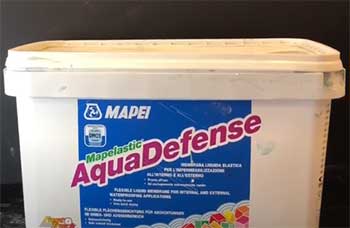
Pros of AquaDefense: The professional’s speed demon
- Ultra-Fast Drying Time: It features a specialized formula that dries in as little as 30 to 50 minutes: I found that I could apply two coats and start tiling before lunch: this results in a massive boost to productivity: I noticed that it is the fastest liquid membrane I have ever used.
- Flood Test Ready in 12 Hours: It utilizes a quick-set chemistry that reaches full waterproof integrity faster than its rivals: I found this perfect for verifying a shower pan’s seal on a tight schedule: this provides a significant advantage for contractors who need to move to the next phase: I noticed it saves a full day of waiting on the job site.
- Low-Odor and VOC Formula: It features a much milder scent that is barely noticeable during application: I found that I didn’t need a heavy-duty respirator for indoor work: this results in a more comfortable environment for both the installer and the homeowner: I noticed that the lack of ammonia makes it feel much safer.
- Smooth and Fluid Application: It utilizes a thinner consistency that glides onto substrates with minimal effort: I found it much easier to roll out onto large floor areas: this provides a more uniform thickness without the “valleys and ridges” found in thicker pastes: I noticed that I used fewer rollers because the product didn’t gum them up.
- Adhesion to a Variety of Substrates: It features a bond strength that works flawlessly on plywood and OSB in interior dry areas: I found it more versatile for transition zones between the shower and the main floor: this results in a consistent crack-isolation layer throughout the room: I noticed it sticks incredibly well to PVC and metal drains.
Cons of AquaDefense: The drawbacks of speed
- Subtle Color Change During Curing: because the teal-to-green shift is less dramatic than RedGard’s pink-to-red: I found it slightly harder to see thin spots in low-light conditions: this results in a need for better lighting and a more careful eye during the second coat: I noticed that it can blend into the shadows of a corner easily.
- Higher Risk of Splatter: because the consistency is thinner and more “paint-like”: I found that it tended to flick off the roller more easily if I moved too fast: this provides a need for more extensive masking and drop cloths: I noticed that the teal droplets are very obvious on white baseboards.
- Lower Crack Isolation Threshold: because the cured film is typically thinner (around 20 mils): I found that it might not bridge larger gaps as effectively as the thicker RedGard: this results in a need for reinforcing fabric on any gap over 1/8 inch: I noticed that I had to be much more meticulous with my mesh tape in the corners.
- Difficulty in Filling Voids: because it is not as “body-heavy” as a paste-style membrane: I found that it didn’t fill the holes in the cement board as well on the first pass: this provides a need for a dedicated “fill” pass with a brush: I noticed I had to work the product into the substrate more manually.
- Limited Availability in Local Shops: because Mapei products are often sold through specialized tile distributors or select retailers: I found it slightly harder to find than RedGard on a Sunday morning: this results in needing to plan your purchase ahead of time: I noticed that if I ran out, I couldn’t just pop over to the nearest hardware store.
Also Read: Comparison Of RedGard Vs. Hydro Ban
Comparison with Others
- RedGard Vs. Laticrete Hydro Ban
I found that Hydro Ban is often considered the “top tier” of liquid membranes.
You should realize that Hydro Ban does not require reinforcing fabric in the corners, which I found to be a massive time saver.
I noticed that while Hydro Ban is excellent, it is significantly more expensive than RedGard.
I believe that RedGard is the better budget-friendly choice for you, but Hydro Ban is the analytical winner for professional-grade speed.
- AquaDefense Vs. Schluter Kerdi
I found that comparing a liquid like AquaDefense to a sheet membrane like Kerdi is like comparing paint to wallpaper.
You should realize that Kerdi is a physical fabric that you thin-set to the wall, which I found provides an absolute guarantee of thickness.
I noticed that AquaDefense is much easier for beginners to apply around complex shapes like niches.
I believe that AquaDefense is the better choice for you if your shower has lots of custom benches and cutouts, whereas Kerdi is the gold standard for flat walls.
- RedGard Vs. TEC HydraFlex
I noticed that TEC HydraFlex is another liquid option that dries very quickly.
I found that HydraFlex has a “sticky” tackiness that I noticed lasted longer than either RedGard or AquaDefense.
You should realize that HydraFlex is often favored for its extreme flexibility.
I believe that RedGard is still the more reliable “all-around” product for you because of its better-documented vapor ratings for steam showers.
Also Read: Comparison Of Mapelastic CI Vs. AquaDefense
Frequently Asked Questions (FAQs)
No, they are made by different companies (Mapei vs. Custom Building Products) and have different drying times, thicknesses, and color-change properties.
“Better” is subjective, but many pros prefer Laticrete Hydro Ban for its lack of required fabric or Schluter Kerdi for its guaranteed thickness as a sheet membrane.
Yes, when applied to the manufacturer’s specified dry film thickness (typically 30 mils), it forms a continuous, completely waterproof and vapor-resistant barrier.
The most common mistake is applying the liquid too thin or skipping the reinforcement of corners and seams with mesh tape.
Final Thoughts
You should buy RedGard if you want a budget-friendly, highly visible product that is widely available and proven for steam showers.
I have found that for most of you, AquaDefense is the better choice if you are working on a tight schedule and want a low-odor, fast-drying experience.
I believe that as long as you follow the “two-coat” rule and prep your surfaces properly, you will never have to worry about a leak behind your tile.